As an Amazon Associate I earn from qualifying purchases. These links may earn PickScoreLab a commission at no additional cost to you.
Quick verdict: The Galaxy S26 Ultra is the better fit when its faster 60W charging, Privacy Display, newer processor, and revised camera hardware solve a specific need. The Galaxy S25 Ultra is the value choice when it costs meaningfully less and its 45W charging, camera system, S Pen, and long support window already meet the workload. Existing S25 Ultra owners should not upgrade on model number alone.
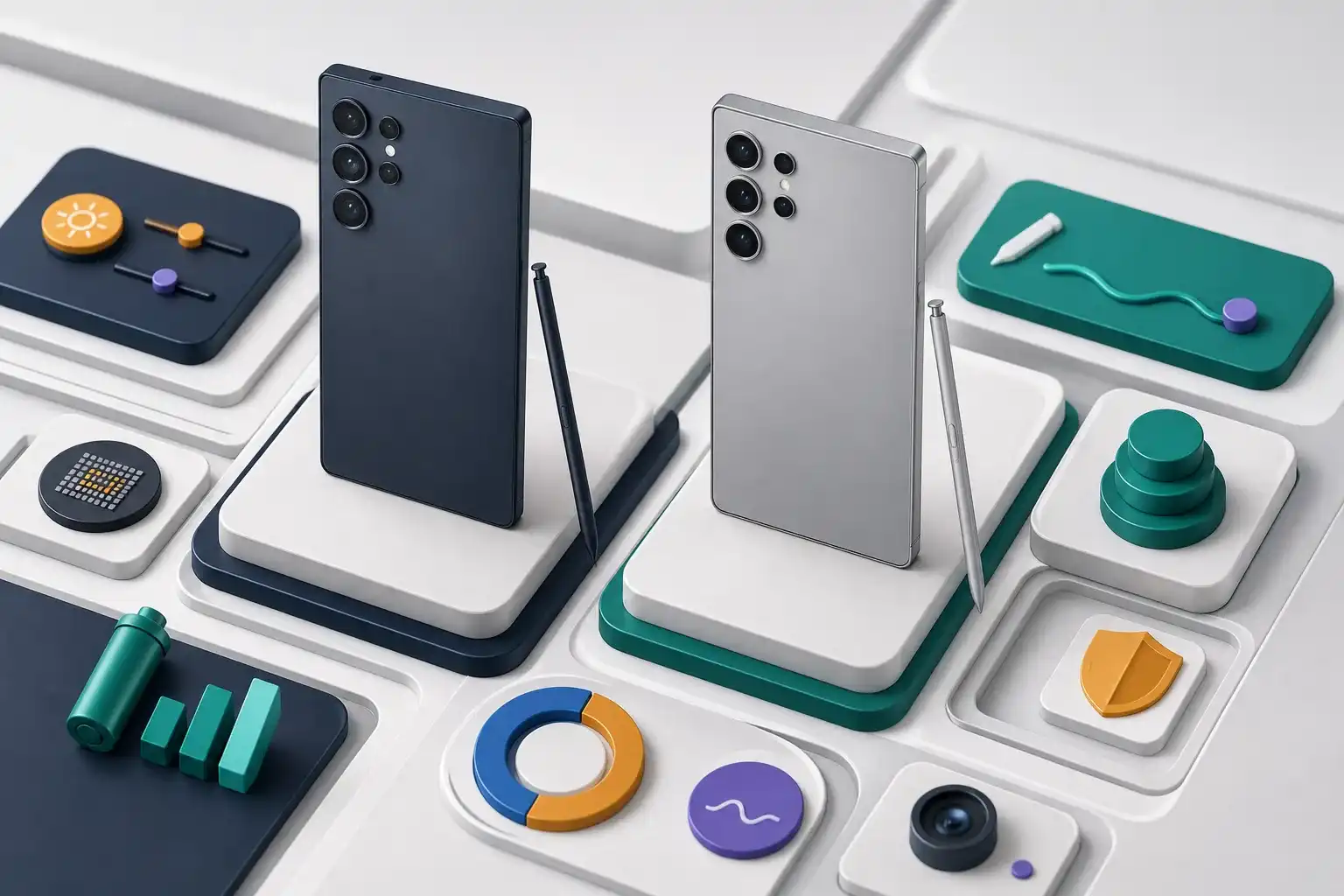
Both phones are large Samsung flagships with a 6.9-inch display, 5,000mAh battery class, integrated S Pen, 200MP main camera, and fixed internal storage. The practical decision turns on price, exact storage configuration, newer features, physical preferences, and how long the phone will remain in service.
Galaxy S25 Ultra vs S26 Ultra specifications
| Decision factor | Galaxy S25 Ultra | Galaxy S26 Ultra |
|---|---|---|
| Display | 6.9-inch QHD+ Dynamic AMOLED 2X, 1–120Hz | 6.9-inch QHD+ Dynamic AMOLED 2X, up to 120Hz |
| Distinctive display feature | Anti-reflective Gorilla Armor 2 | Built-in Privacy Display |
| Processor | Snapdragon 8 Elite for Galaxy | Snapdragon 8 Elite Gen 5 for Galaxy |
| Main camera | 200MP, F1.7 | 200MP, F1.4 |
| Ultrawide | 50MP | 50MP |
| Long telephoto | 50MP, 5x optical | 50MP, 5x optical |
| Short telephoto | 10MP, 3x optical | Verify current Samsung camera specification |
| Battery | 5,000mAh typical | 5,000mAh typical |
| Wired charging | Up to 45W | Up to 60W |
| Storage choices | 256GB, 512GB, 1TB | Verify exact regional configuration |
| Weight | 218g | 214g |
| S Pen | Integrated | Integrated |
| Water-resistance claim | IP68 | IP68 |
Published specifications do not establish real-world battery life, camera quality, sustained performance, thermals, modem reliability, or comfort. Those require controlled testing and depend on software and conditions.
The case for buying the Galaxy S25 Ultra
The S25 Ultra is the more rational purchase when its final price is substantially lower. It already supplies the core Ultra experience: a large QHD+ 120Hz display, integrated S Pen, four rear focal-length options, Snapdragon flagship performance, and a long update commitment.
Its camera system remains versatile. The 200MP main, 50MP ultrawide, 50MP 5x telephoto, and 10MP 3x telephoto cover a wider range than most ordinary phones. Buyers who mainly photograph people, travel, documents, and everyday scenes may not gain enough from the newer model to justify a large price gap.
The S25 Ultra is also the safer value when you can buy a new U.S. model from a clear seller and warranty channel. A discounted older flagship with predictable condition can be better than a newer model from an uncertain marketplace configuration.
The case for buying the Galaxy S26 Ultra
The S26 Ultra makes sense when its new features match a real workflow.
Privacy Display is the most distinctive change. Samsung describes it as a built-in viewing-control system that reduces side visibility. It can help when reading messages or working in shared spaces, but it is not a security system. It cannot prevent screenshots, malware, shoulder viewing from every angle, unlocked-device access, or data leakage through apps.
The newer processor raises the performance ceiling, while 60W wired charging can reduce charging time with compatible equipment. The main camera’s wider published aperture may change light collection and imaging behavior, though a specification alone does not prove better final images.
Buy the S26 Ultra when those differences are worth the actual price premium—not because it is one generation newer.
Display comparison: reflections versus privacy
The S25 Ultra emphasizes an anti-reflective Gorilla Armor 2 front. Reducing reflections can improve practical visibility in bright environments and may make the display easier to read without continuously increasing brightness.
The S26 Ultra adds Privacy Display controls. This serves a different need: reducing what people beside the user can see. Buyers should determine whether privacy viewing is useful in commuting, travel, offices, healthcare, finance, or other shared environments.
Privacy viewing may involve tradeoffs in angle, perceived brightness, color, or how content looks to the owner. The feature should be evaluated in person if it is a primary purchase reason.
For ordinary use, both offer the same broad 6.9-inch high-refresh flagship display class. Neither solves the physical problem of a large, wide phone.
Camera comparison
Both phones retain a 200MP main-camera headline and a 50MP 5x telephoto class. The S25 Ultra also lists a 50MP ultrawide and 10MP 3x telephoto. Samsung’s S26 materials should be checked for the exact regional camera configuration before ordering.
The S26 Ultra main camera’s F1.4 published aperture is wider than the S25 Ultra’s F1.7. In principle, a wider aperture can admit more light, but image results also depend on sensor readout, lens design, stabilization, shutter choice, processing, noise reduction, subject movement, and software.
An upgrade is easier to justify for users who:
- Frequently shoot in low light.
- Depend on long telephoto framing.
- Record substantial video.
- Use the phone as a primary camera for work.
- Have identified a specific limitation in their S25 Ultra results.
If the existing camera already meets the need, specification changes alone are weak reasons to replace a one-generation-old flagship.
Performance and AI
The S26 Ultra’s Snapdragon 8 Elite Gen 5 for Galaxy is newer than the S25 Ultra’s Snapdragon 8 Elite for Galaxy. That should provide a higher capability ceiling, but daily differences depend on the workload.
Messaging, web browsing, streaming, maps, notes, and ordinary photography already fit comfortably within the S25 Ultra’s hardware. Heavy games, local AI processing, video editing, emulation, and prolonged multitasking are more likely to expose performance differences.
Sustained speed depends on heat and power management. Peak benchmark figures cannot reveal frame stability after a long session or behavior in a warm environment.
Samsung AI features also change through software. Some features may require an account, internet connection, supported language, region, or future service terms. Do not make a multi-year hardware purchase around one software feature without checking availability and terms.
Battery life and charging
Both use a 5,000mAh typical battery class. That does not mean equal endurance. Processor efficiency, modem, display, camera activity, signal, apps, software, and temperature all affect runtime.
The clear specification difference is wired charging: up to 45W on the S25 Ultra and up to 60W on the S26 Ultra. Reaching either maximum requires compatible charging equipment and favorable battery conditions.
Faster charging matters most to users who top up in short windows. It matters less to overnight chargers or users whose phone comfortably lasts a day. Evaluate charging time as part of the routine rather than treating wattage as a general performance score.
Existing S25 Ultra owners with poor endurance should check battery condition and software behavior before assuming the S26 Ultra is the only solution.
Size, weight, and comfort
The S26 Ultra is listed at 214g, four grams lighter than the S25 Ultra’s 218g. Both remain large phones. Case choice can add more weight than the generational difference removes.
Comfort depends on width, corner shape, balance, grip, case material, and hand size. Buyers should not assume the lighter specification guarantees better one-handed use.
If size is already the main complaint with the S25 Ultra, another Ultra may not solve the problem. Compare a smaller Galaxy or standard flagship before upgrading.
S Pen and productivity
Both phones include an integrated S Pen. Notes, annotation, precise selections, signatures, and document markup remain central Ultra advantages.
Before choosing, verify the exact S Pen capabilities on each model. Samsung can change remote, gesture, Bluetooth, or software behavior between generations. Buyers replacing an older Note or Ultra should not assume every legacy feature persists.
If the S Pen rarely leaves its slot, its presence should not justify the Ultra premium. The S25 Plus or another large phone may provide better value.
Storage choice can matter more than generation
Fixed storage means the selected capacity stays with the phone for its useful life. A 512GB S25 Ultra can be more practical than a 256GB S26 Ultra for heavy camera, game, offline media, or creative workloads.
Compare:
- Current local storage use.
- Annual photo and video growth.
- Large games and offline downloads.
- Cloud subscription and upload habits.
- Expected ownership period.
- Resale value of the capacity tier.
Do not compare only the lowest advertised prices when the capacities differ.
Software support and ownership horizon
Samsung announced seven OS generations and seven years of security updates for the S25 series. The newer S26 generation naturally begins later and should retain a longer remaining support horizon when equivalent policies apply.
For a buyer keeping the phone many years, one additional generation can matter. For a buyer replacing hardware after two or three years, condition, battery, storage, and purchase price may matter more.
Support eligibility can differ with region and model. Confirm the exact device rather than relying on a family name.
New S25 Ultra versus renewed S25 Ultra
A renewed S25 Ultra may create the largest apparent savings, but it introduces battery, IMEI, repair, cosmetics, accessories, warranty, and water-resistance uncertainty.
Compare three distinct options:
- New S25 Ultra with clear U.S. warranty.
- Renewed S25 Ultra with verified condition and return protection.
- New S26 Ultra with newer hardware and support horizon.
The renewed device should not be compared to the S26 Ultra as if both have equivalent condition and support.
Which should an S25 Ultra owner choose?
Keep the S25 Ultra unless at least one S26 Ultra change solves a repeated problem:
- Privacy Display is useful in daily shared-space work.
- 60W charging materially improves the routine.
- A specific camera improvement matters to paid or frequent work.
- New processor capability is required by a real application.
- The existing phone has capacity or hardware limitations that are uneconomical to fix.
Upgrading for novelty alone produces poor value and more setup effort. A battery service, storage cleanup, new case, or charger may solve the actual issue at lower cost.
Which should a new buyer choose?
Choose the S25 Ultra when:
- It is new, correctly configured, and meaningfully cheaper.
- 45W charging is sufficient.
- Privacy Display is unnecessary.
- Its remaining support window covers the ownership plan.
- The exact storage tier is better for the budget.
Choose the S26 Ultra when:
- Privacy Display is valuable.
- Faster wired charging matters.
- The newer processor or camera changes meet a defined need.
- The longer remaining support horizon justifies the premium.
- The exact listing has clearer seller and warranty terms.
Buying checklist
- Compare the same storage capacity and condition.
- Confirm U.S. model, carrier support, eSIM, and warranty.
- Check seller, return window, included accessories, and charger requirements.
- Decide whether Privacy Display solves a real problem.
- Estimate whether 60W charging changes the routine.
- Compare camera needs by focal length and workload.
- Include case, charger, protection, and possible trade-in value.
- For renewed units, inspect battery, IMEI, repairs, and warranty separately.
Common questions
Is the Galaxy S26 Ultra much better than the S25 Ultra?
It is newer and adds meaningful specifications, but “much better” depends on the workload. Privacy Display, faster charging, and newer processing are useful only when the buyer benefits from them.
Should I upgrade from the S25 Ultra?
Usually not unless a specific S26 feature resolves an actual limitation. The S25 Ultra remains a capable flagship with long support.
Which phone has better battery life?
The shared 5,000mAh capacity does not answer that. Real endurance requires comparable testing under the same software, signal, settings, and workload.
Is the S25 Ultra the better value?
It can be when the exact new configuration costs meaningfully less. A small discount may not compensate for the S26 Ultra’s newer features and longer remaining support.
Is 256GB enough?
It can be for cloud-first users. Frequent high-resolution video, large games, offline media, or long ownership may justify 512GB. Compare equal capacities when evaluating price.
Bottom line
The Galaxy S26 Ultra is an evolution for buyers who value privacy viewing, faster charging, newer processing, and its revised camera system. The Galaxy S25 Ultra remains the stronger value when discounted, correctly configured, and purchased with clear condition and warranty.
The best decision is not “newer versus older.” It is whether the newer features create enough daily value to exceed the price difference.
Check the available Amazon listing
Confirm each ASIN, configuration, seller, warranty, return terms, and current specifications. Prices and availability can change.
As an Amazon Associate I earn from qualifying purchases. These links may earn PickScoreLab a commission at no additional cost to you.
Read the individual reviews
Sources and further reading
- Samsung — Galaxy S25 Ultra product page
- Samsung Newsroom — Galaxy S25 series introduction
- Samsung — Galaxy S25 series specification sheet
- Samsung — Galaxy S26 Ultra product page
- Samsung Support — Galaxy S26 Ultra Privacy Display
Product specifications, software support, seller terms, price, and availability can change. Confirm the exact model and current manufacturer documentation before buying.